



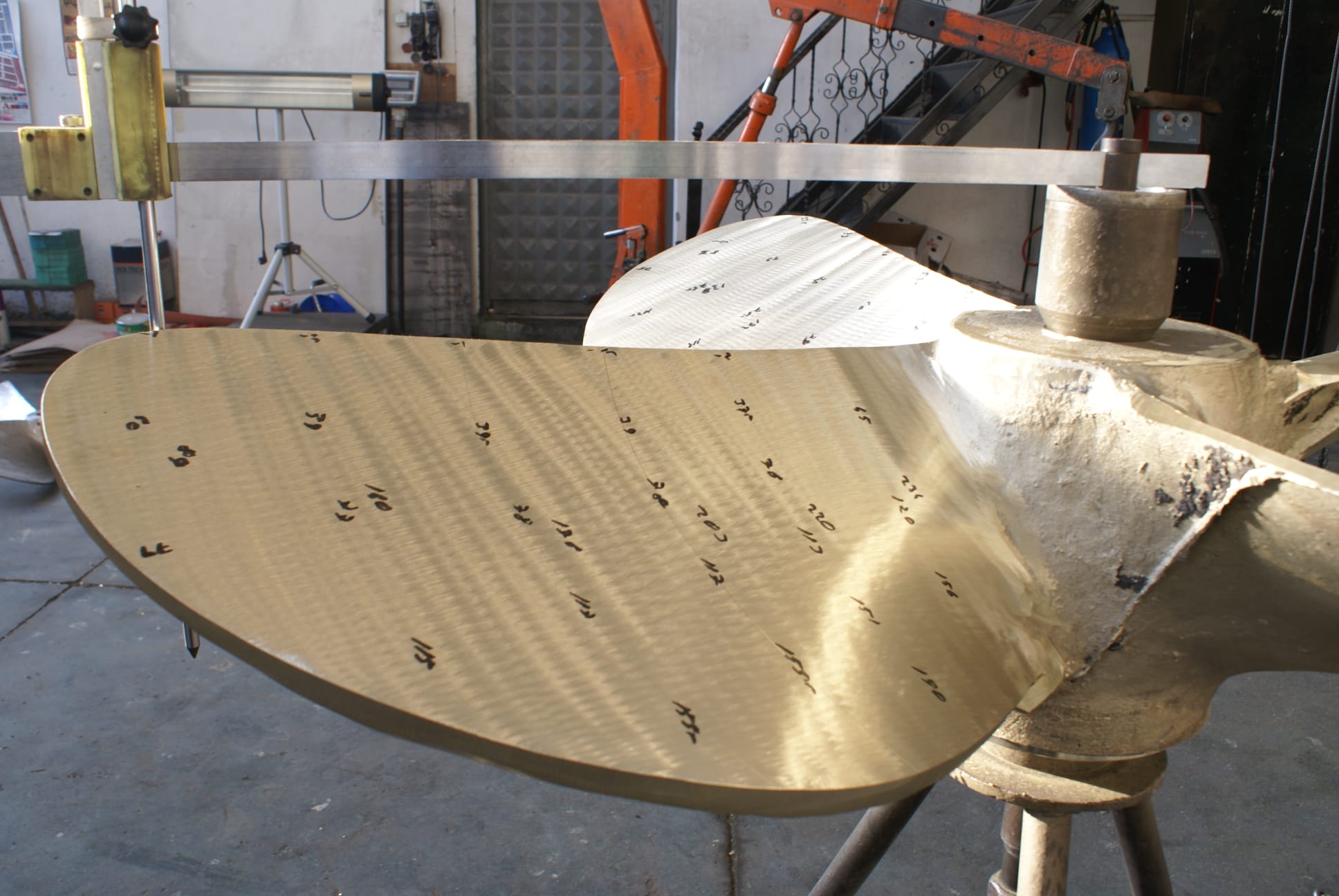
In the maritime world, your boat's performance doesn't just depend on your engine's horsepower; it depends on how efficiently you transfer that power to the water. The star of this critical underwater power transfer is the propeller. While many boat owners pay close attention to engine maintenance, they often overlook how an improperly sized propeller can drastically increase fuel consumption or shorten engine life.
So, what exactly do the frequently used terms "Diameter" and "Pitch" mean when it comes to propeller selection?
What is Diameter?
Diameter is the distance across the circle drawn by the tips of the propeller blades as it rotates. Essentially, it's twice the distance from the center of the hub to the tip of a blade.
- Large diameter propellers: Generally preferred for larger, heavier, and slower-moving boats. Because they grip a larger volume of water, they provide higher thrust and better maneuverability.
- Small diameter propellers: Typically used on lighter speedboats where top-end speed is the primary goal.
What is Pitch?
Pitch is the theoretical forward distance, measured in inches, that a propeller would travel through the water in one complete revolution (assuming there is no "slip").
The easiest way to understand this is to think of the propeller as a screw and the water as a block of wood. The distance the screw drives into the wood with one full turn is its pitch. For example, a 21-pitch propeller will theoretically move the boat 21 inches forward in one complete revolution.
The Consequences of Incorrect Pitch Selection
Your propeller's dimensions must perfectly match your boat's weight, hull design, and the engine's recommended RPM range. Deviating from the optimal specifications leads to the following issues:
1. If the Pitch is Too Low (Under-propped)
- The engine will exceed its recommended maximum RPM, resulting in an "over-rev" situation.
- The boat's top speed will decrease.
- Engine components will wear out much faster than normal, and overheating issues may occur.
2. If the Pitch is Too High (Over-propped)
- The engine will struggle to reach its target operating RPM (known as "lugging").
- Just like driving a car uphill without downshifting, an extreme load is placed on the engine.
- Acceleration (hole-shot) performance drops significantly, and fuel consumption skyrockets.
How to Choose the Right Propeller?
Choosing the right propeller shouldn't be a game of trial and error; it requires engineering calculations. Variables such as the boat's displacement, waterline length, gear ratio, and engine power are all crucial parts of this equation.
At Eris Propellers, with our years of casting and manufacturing expertise, we don't just produce propellers; we stand by your side to help you find the perfect match for your vessel's unique characteristics. You can use the calculation tools on our website to find the most accurate dimensions for your system, or contact our expert engineering team directly for support.